


Impact of Late Payment on CIBIL Score
Since payment history is the most important factor, late payments have a strong impact on your CIBIL Score. Missed or delayed payments are reported to credit bureaus and can remain for up to seven years, thereby affecting future credit eligibility. Timely payments, reminders, and auto-pay can help protect and gradually improve your score.

Do Late Payments Affect Credit Score?
Yes, late payments can impact your credit score. missed or delayed payments signal poor repayment discipline and as the lenders report payment history to credit bureaus, it can significantly lower your score, even if it happens once.
What Happens to Your Credit Report After a Late Payment?
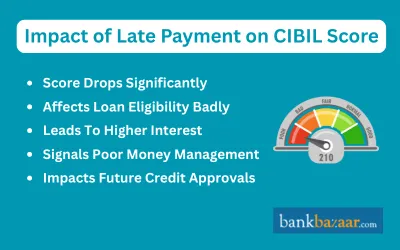
Once a lender reports a late payment, it is recorded in your credit report with key details, as outlined below:
- Number of days the payment was overdue, such as 30 days, 60 days, or more than 90 days.
- Account type, such as credit card, loan, etc.
- Current status of the account (active or still overdue)
Note: The late payment record can remain on your credit report for up to seven years. Its impact reduces over time if you maintain timely payments going forward.
How Much Can a Late Payment Lower Your Credit Score?
How much the late payment would impact your credit score varies depending on several factors, such as:
- Your current credit score
- Duration of the payment delay
- Number of accounts impacted
- How recent the late payment was
How Late Payments Impact Your CIBIL Score?
Even small payment delays can negatively impact your CIBIL Score in both the short and long term. The impact of late payments on your CIBIL score are mentioned below:
- Immediate impact: Late payments are reported to credit bureaus and can cause an instant drop in your CIBIL Score.
- Long-term effect: A pattern of poor repayment behaviour is created due to repeated delays, leading to a sustained decline in your score.
- Impact on future credit: Loan or credit card approvals become more difficult, if a history of late payments signals higher risk to lenders.
How Missed EMIs Severely Damage Your CIBIL Score?
Missing an EMI has a far more serious impact on your credit profile and those are listed below:
- Significant drop in CIBIL score: A missed EMI can cause a sharp and immediate fall in your CIBIL Score.
- Reported to credit bureaus: The missed EMIs are reported to the credit bureaus by the lenders, where the negative record stays on your credit report for several years.
- Reduced credit eligibility: A missed EMI makes you appear high-risk, greatly reducing your chances of approval for future loans or credit cards.
How to Recover from a Late Payment?
To recover from a late payment, follow the below-mentioned steps:
- To limit further impact, pay immediately and clear the overdue amount as soon as possible.
- Set reminders by using alerts or apps to track payment due dates.
- Automate payments to avoid missing future payments.
- Talk to your lender so that the first-time delays may be removed as a goodwill gesture.
- Check your credit report regularly for errors or delayed updates.
- Consistent on-time payments gradually help rebuild your credit score.
How to Avoid Late Payments?
To maintain a healthy credit profile, avoiding late payments is essential and follow the below-mentioned steps to do so:
- Repay the full balance of credit cards every month.
- Track EMIs and due dates using a calendar or budgeting app.
- To avoid last-minute issues, make payments a few days before the due date.
- To manage unexpected expenses, keep an emergency fund.
- Review your credit report quarterly to ensure all accounts are in order.
How Long Does a Late Payment Stay on Your Credit Report?
Late payments can affect your credit profile for several years. Here’s how they impact your CIBIL Score:
- A late payment remains on your credit report for up to seven years from the default date.
- Even a single missed EMI or credit card payment is reported and can lower your score.
- Time repayments reduce the impact over time, which is usually the highest initially.
- Repeated late payments can compound the damage and reduce future credit approvals.
Real-Life Challenges of a Low CIBIL Score
A low CIBIL Score can create multiple practical difficulties in your financial life and some of the real-life challenges are listed below:
- As lenders view borrowers with low CIBIL scores as a higher-risk borrower and hence loans approved with a low CIBIL Score often carry higher interest.
- Applicants of home loans, car loans, personal loans, and emergency credit applications with low CIBIL score may be denied outright.
- A low score can lead to declined applications or cards with low limits and high interest, as credit card issuers prefer high scores.
- Landlords or employers may check your credit history, affecting rentals or jobs involving financial responsibility.
Steps to Take if You Miss a Payment
If you miss or may miss a payment, limit damage to your credit report responsible by following the below-mentioned steps:
- Contact your lender immediately and explain your situation honestly as early communication shows responsibility and may increase chances of assistance.
- To know the full cost of the missed payment, ask about late fees, penalty interest, or other charges.
- Negotiate a payment plan and discuss options, such as revised schedules or temporary deferment instead of ignoring the problem.
Tips for Improving and Keeping a Good CIBIL Score
Building and maintaining a good CIBIL Score requires consistent discipline and smart credit habits. Key steps to improve and maintain good CIBIL score are mentioned below:
- Ensure all EMIs and credit card bills are paid within due dates using reminders or auto-debit.
- To show responsible borrowing, maintain credit utilisation below 30% of your available limit.
- Review your credit report regularly (one free report is provided annually from each bureau).
- To keep your report accurate, fix any incorrect or missed payment entries with the credit bureau.
Delayed payments and credit scores
To have a good credit score, it is not only crucial that you pay back the principal with interest, but do so at the time stipulated. There are three ways delayed payments could hurt your credit score and your pocket. These are:
Default makes fund allocation difficult: Lenders also take into account your timely repayment schedule to distribute their funds, and if your default prevents them from lending to other borrowers, then they are justified in charging you a high penalty. By reporting your default to CIBIL, they are essentially conveying your 'risky' behaviour to other lenders.
A low CIBIL score can be hard to erase: When banks and financial institutions report defaults, CIBIL updates them on its score and considers it as 'status quo' until the bank communicates otherwise. This can be hard to remove and may take months and years of sustained, responsible behaviour by the borrower (by making adequate, and timely repayments) to regain a normal score.
It nullifies your accumulated reputation: Even if you have been a good borrower and paid off instalments timely in the past, one default could erase that reputation from your credit score. As a result, you will find access to credit extremely difficult.
It could hurt your pocket: When you enter into a contract with a bank or financial company for a loan or a credit card, they include steep penalty rates/late payment fees for any delayed payment, and you could end up being the loser.
With the interlinking of most forms of credit with CIBIL scores—be it Personal Loans, Two/Four Wheeler Loans, Home Loans it is now imperative for every borrower to maintain good credit score if they wish to borrow funds for any need.
As a borrower, what steps can you take?
As a credit card or personal loan holder you know that all your transactions are under the scanner by CIBIL and your credit record is liable to get affected if you do not clear outstanding dues on time or make a default.
Come what may, try to settle your credit cards bills in full because a late payment can make an adverse entry on your credit report; one that takes months, even years to get rid of. Similarly, if you make a default on the instalment of your loan, banks and financial institution may make an adverse report to CIBIL.
How to Avoid Late Payments?
If you are a credit card holder or borrower of any type of loan, then you must regard the due date of making repayment/instalment as the absolute deadline.
- Keep your details updated: Sometimes you may forget to update details like latest address, phone number and email ID with the bank or finance institution and the credit card statement or the instalment notice may not reach you in time. To avoid this, always keep your details updated with the lender so that you can make timely payments.
- Auto-debit a salary account: If you have a salary account with the issuing bank or any other bank, you may leave a standing instruction with your credit card or loan provider to debit the minimum or outstanding amount by a particular date. This works fine when a borrower is very busy and can't find time to keep track of your card and loan payments.
- Spread your credit usage over many cards: If you hold several credit cards, it is wiser to spread your spends across cards rather than concentrating on one particular card. It can help maintain your credit utilisation ratio.
- Convert dues to EMIs: Some credit cards give the option of converting the outstanding on your credit card into EMIs so if you don't think you can pay the outstanding in full by the due date, considering converting them to EMIs and paying it on time.
- Allow buffer time if you pay by cheques or Bill pay: Sometimes customers make payments by dropping a cheque or using third party services like Bill Pay to make payments. But understand that a cheque requires two to three days' time to be cleared and so do third party payments.
- Borrow from friends but pay in time: If you do not have the funds but a payment date is fast approaching, you can ask your friends or relatives for a short-term loan to meet the deadline. But skipping the deadline can create havoc with your credit score.
Disclaimer
Display of any trademarks, tradenames, logos and other subject matters of intellectual property belong to their respective intellectual property owners. Display of such IP along with the related product information does not imply BankBazaar's partnership with the owner of the Intellectual Property or issuer/manufacturer of such products.


FAQs on Impact of Late Payment on CIBIL Score
1.Do late payments affect the CIBIL score?
Yes, late payments lower the CIBIL score, impacting loan or credit card approvals.
2.Will missing a credit bill payment impact my credit score?
Yes, missing credit card bill payments are reported to CIBIL and if it is not paid within a specified period, lenders record it as a late payment. Non-payment of bills for specific duration lowers your CIBIL score.
3.Can late payments be removed from the credit report?
Yes, late payment can be reomved from the credit report only if it is reported as an error. You can file dispute the error with CIBIL to rectify the error, but genuine error cannot be erased and remains on the credit report.
4.How long does a late payment stay on the credit report?
Late payments linger for seven years, but their impact diminishes with consistent timely payments.
5.How much can a late payment lower my credit score?
Late payments can drop your credit score by 80 to 100 points, potentially shifting your credit category.
6.How to check if a late payment is on my credit report?
Sudden credit score drops may signal a late payment. Obtain a free credit report annually or subscribe for more frequent checks.
7.When is a late payment recorded on the credit report?
A late payment is recorded when it's 30 days past the due date unless settled before the 30-day mark.
8.Can a single day of late payment affect my credit score?
Yes, even a single day of late payment can negatively impact your credit score.
9.Does a 7-day late payment affect my credit score?
Less than 30 days past due is less impactful, but a 30-day or more delay is considered serious, affecting credit scores.
10.How long does it take to recover from one late payment?
Recovery time depends on credit history, the severity of the late payment, and credit scoring model.
11.How long does CIBIL keep track of the defaulter?
CIBIL retains borrower information for a minimum of seven years from the first payment default.
12.How can I get a late payment removed from my credit report?
Making timely repayments and establishing a positive payment history may lead to the removal of a late payment remark.
CIBIL Score Requirements for Loans

Disclaimer
Credit Card:
Credit Score:
Personal Loan:
Home Loan:
Fixed Deposit:


Copyright © 2026 BankBazaar.com.